
Many-body correlations, phase transitions and clustering
7-11 September
Many-body correlations, phase transitions, and clustering: how to identify and quantify them?
Organizers: C. W. Johnson (San Diego State Univ., contact), N. Sandulescu (IFIN-HH), A. Volya (Florida State Univ.)
Talks and seminars during the first week (07/09-11/09); working group: one week.
DETAILED PROGRAM:  WorkshopESNTpairing2026vSept.pdf SCHEDULE: ProgESNTpairingSept2026.pdf
The structure of atomic nuclei reflects a delicate interplay between single-particle motion and collective correlations. Phenomena such as pairing, shape coexistence and clustering exemplify how complex emergent behavior arises from fundamental nucleon–nucleon interactions.
In recent years, major progress has been achieved in ab initio, shell-model, and energy-density functional approaches, as well as through advanced experimental probes. However, the field still lacks unified diagnostics capable of quantifying the degree of collectivity, correlation, and condensation in a model-independent manner.
Goals of the workshop
(i) To discuss how correlations and clusterisations are treated in various models and how they manifest in experimental data.
(ii) To discuss how to identify and to quantify, theoretically and experimentally, the emergence of quantum phase transitions associated to pairing and alpha-like condensation.
(iii) To explore the methods employed to describe correlations, phase transitions and condensation in condensed matter superfluidity, ultracold gases and quantum information, and to discuss how they can be applied to nuclear systems.
List of speakers and talks
+ M. Assié (IJCLab Orsay) Probing neutron-proton pairing through pair transfer: the Anderson limit in nuclei
+ F. Barranco (University of Sevilla) Nuclear Josephson effect, theoretical aspects and predictions TalkESNT7Sept26_FBarranco.pdf
+ D. Beaumel (IJCLab Orsay)
Approach to nuclear clustering in the ground-state of neutron-rich nuclei via direct reactions: first studies in inverse kinematics at RIKEN and GANIL
+ O. Bessidskaia-Bylund (IJCLab, Orsay)
Photoproduction of vector mesons at the LHC as a probe of nuclear geometry TalkESNT11sept26_OBylund.pdf
+ B. Cederwall (KTH Royal Institute of Technology, Stockholm) Probing pairing and its isospin modes at finite angular momentum
TalkESNT7sept26_BCederwall.pdf
+ L. Corradi (INFN-LNL, Legnaro) Sub barrier transfer reactions and the nuclear Josephson effect TalkESNT7Sept26_LCorradi.pdf
+ D. Gambacurta (INFN Catania) Coherence and Collectivity in nuclear excitations TalkESNT9sept2026_DGambacurta.pdf
+ N. Gavrielov (Hebrew University) Shape-phase transitions and configuration crossing in the A ~ 100 region
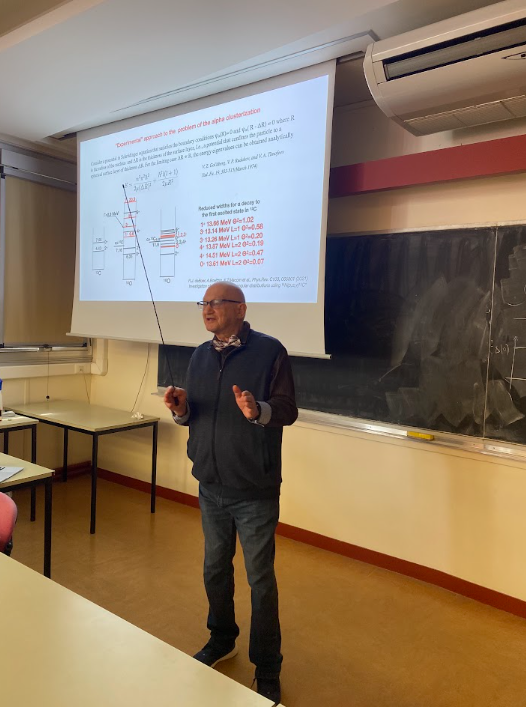
+ V. Goldberg (Texas A&M) Alpha-Cluster Structure of Neutron-Rich Nuclei between 16O and 20Ne OPEN SEMINAR
TalkESNT10sept26_VGoldberg.pdf
+ L. Heitz (CEA DAM) Localization/clustering from ab initio methods
+ N. Itagaki (Osaka Metropolitan University) Exotic clustering of light nuclei TalkESNT10sept26_NItagaki.pdf
+ C. W. Johnson (SDSU, San Diego) Can the ground state have a temperature? And other questions TalkESNT11sept26_CWJohnson.pdf
+ D. Lee (Michigan State University) Multimodal superfluidity of neutrons and neutron-rich nuclei TalkESNT8Sept26_DLee.pdf
+ E. Litvinova (Western Michigan University)
Spectral imprints of nuclear many-body correlations: constraining theory toward the spectroscopic accuracy frontier
TalkESNT9sept26_ELitvinova_I.pdf TalkESNT9sept26_ELitvinova_II.pdf
+ P. Magierski (Warsaw University of Technology) Stability and Dissipative Dynamics of Collective Modes in Ultracold Atomic Gases
TalkESNT9sept26_PMagierski.pdf
+ A. Nurmukhanbetova (Nazarbayev University) The 12C + 12C Interaction in Astrophysics and Cluster Structure in 24Mg
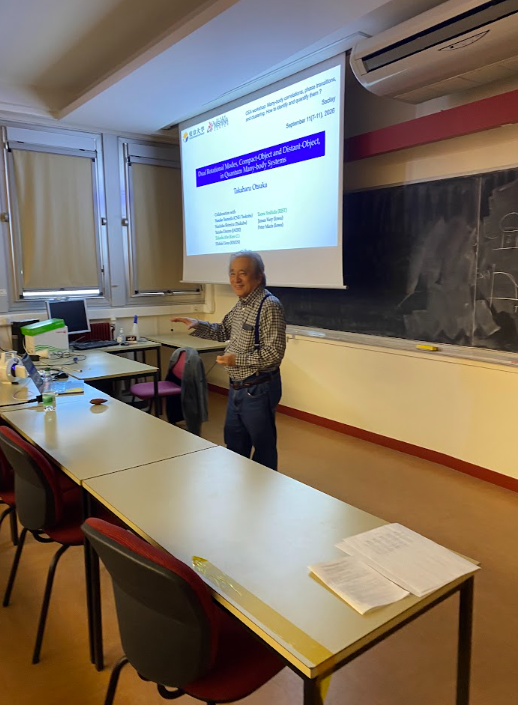
+ T. Otsuka (University of Tokyo)
Dual rotational modes, compact-object and distant-object, in quantum many-body systems TalkESNT11Sept26_TOtsuka.pdf
+ N. Sandulescu (IFIN-HH, Bucharest) Quartet correlations in N=Z nuclei TalkESNT8sept26_NSandulescu.pdf
+ P. Van Isacker (GANIL) Counting pairs in the shell model TalkESNT8Sept26_PIsacker.pdf
+ A. Volya (Florida State University) Configuration-interaction studies of nuclear alpha clustering TalkESNT10sept26_AVolya.pdf
Schedule
|
Monday 7 Sept. |
Tuesday 8 Sept.
|
Wednesday 9 Sept.
|
Thursday 10 Sept.
|
Friday 11 Sept.
|
|
| 9h30 | Welcome | Discussions | Discussions |
Discussions |
Discussions |
|
9h40 |
M. Assié
|
P. Van Isacker | E. Litvinova | D. Beaumel | O. Bessidskaia-Bylund |
| 10h30 | Break | Break | Break |
Break |
Break |
| 11h | B. Cederwall | D. Lee | P. Magierski |
11h SEMINAR V. Goldberg
|
A. Nurmukhanbetova |
| 11h50 | Discussions | Discussions | Discussions | Discussions | Discussions |
| 12h | Lunch |
Lunch |
Lunch |
Lunch | Lunch |
| 14h | F. Barranco | N. Sandulescu | D. Gambacurta |
N. Itagaki
|
T. Otsuka |
| 14h50 | Break | Break | Break | Break | Break |
| 15h20 | L. Corradi | N. Gavrielov | L. Heitz |
A. Volya
|
C. Johnson |
| 16h | Discussions | Discussions |
Discussions |
Discussions | |
| 17h | End |
End |
End |
End |
|
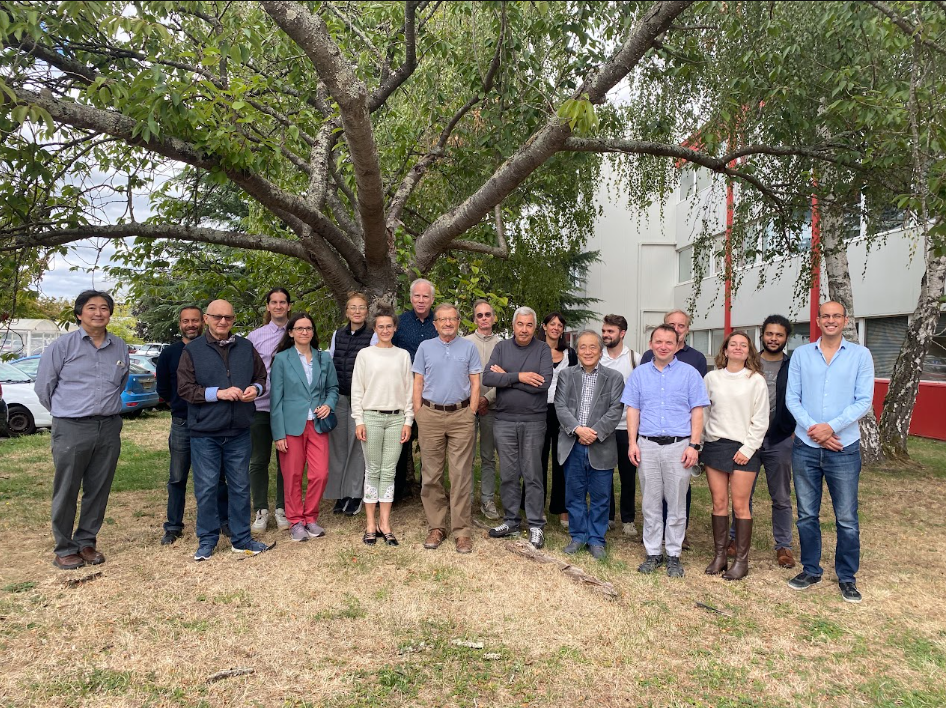
GROUP Photo (click to enlarge)
 |
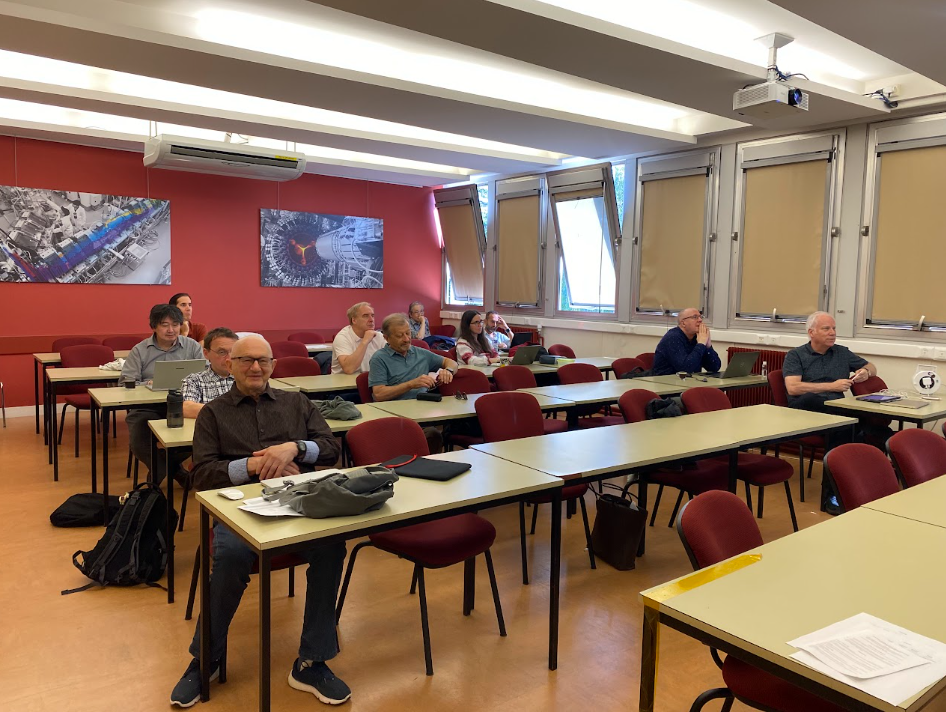
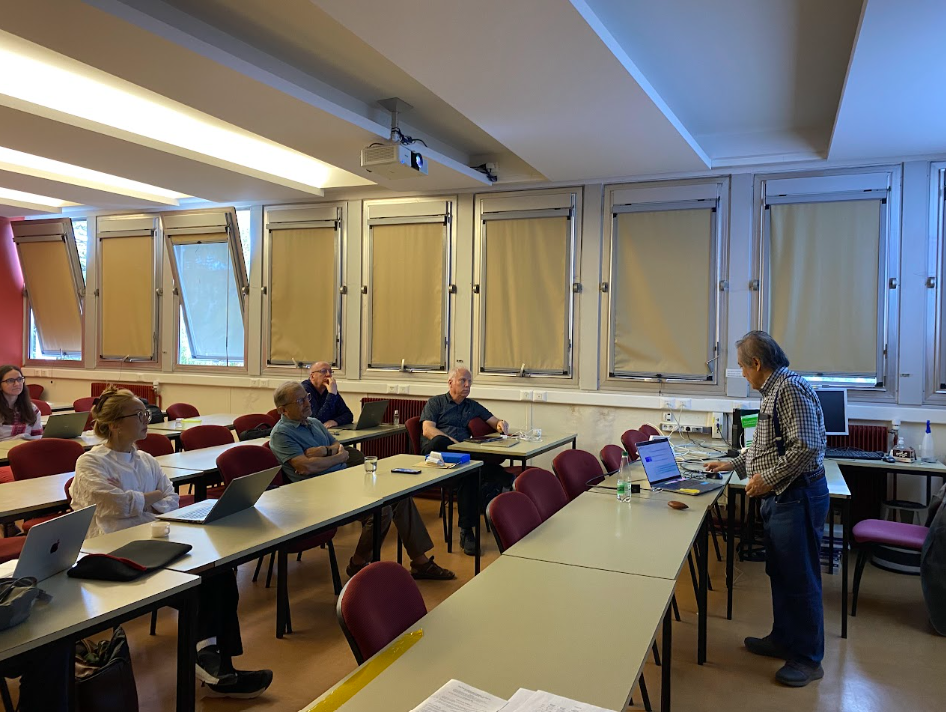
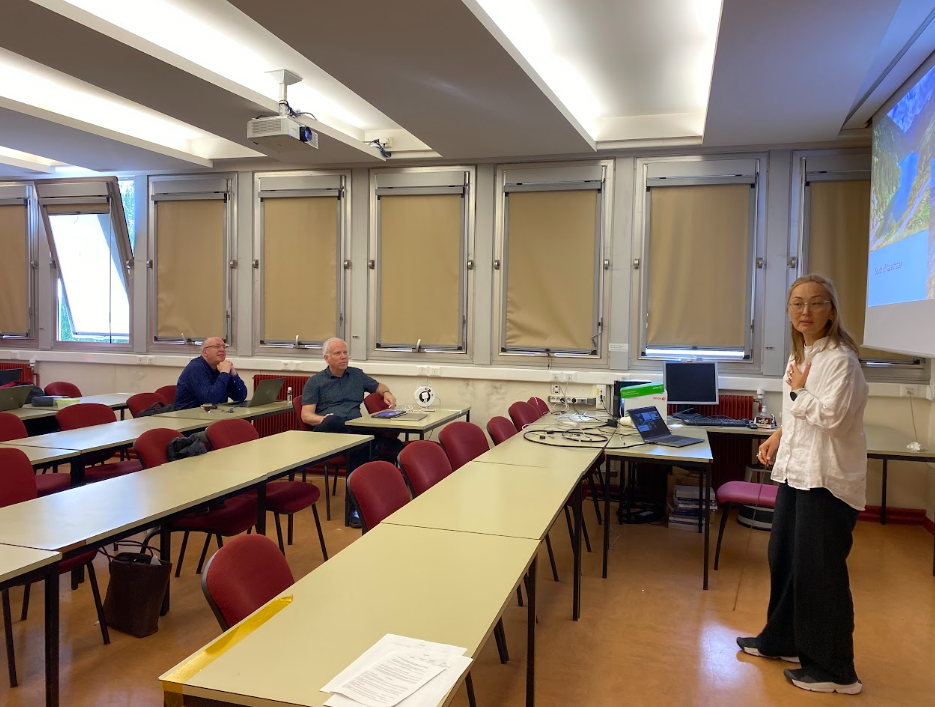
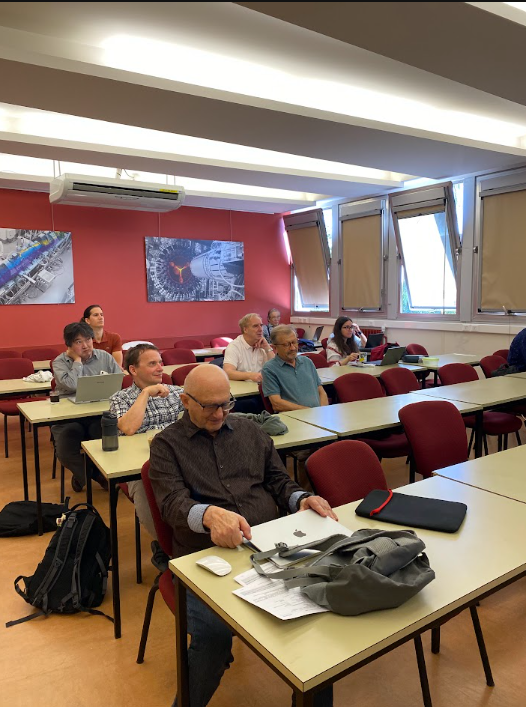
Photos during the workshop (taken by E. Litvinova during the talks) (click to enlarge)
 |
 |
 |
 |
 |
 |
Retour accueil ESNT Back to the ESNT page
Création-contact Web ESNT : Valérie Lapoux

